

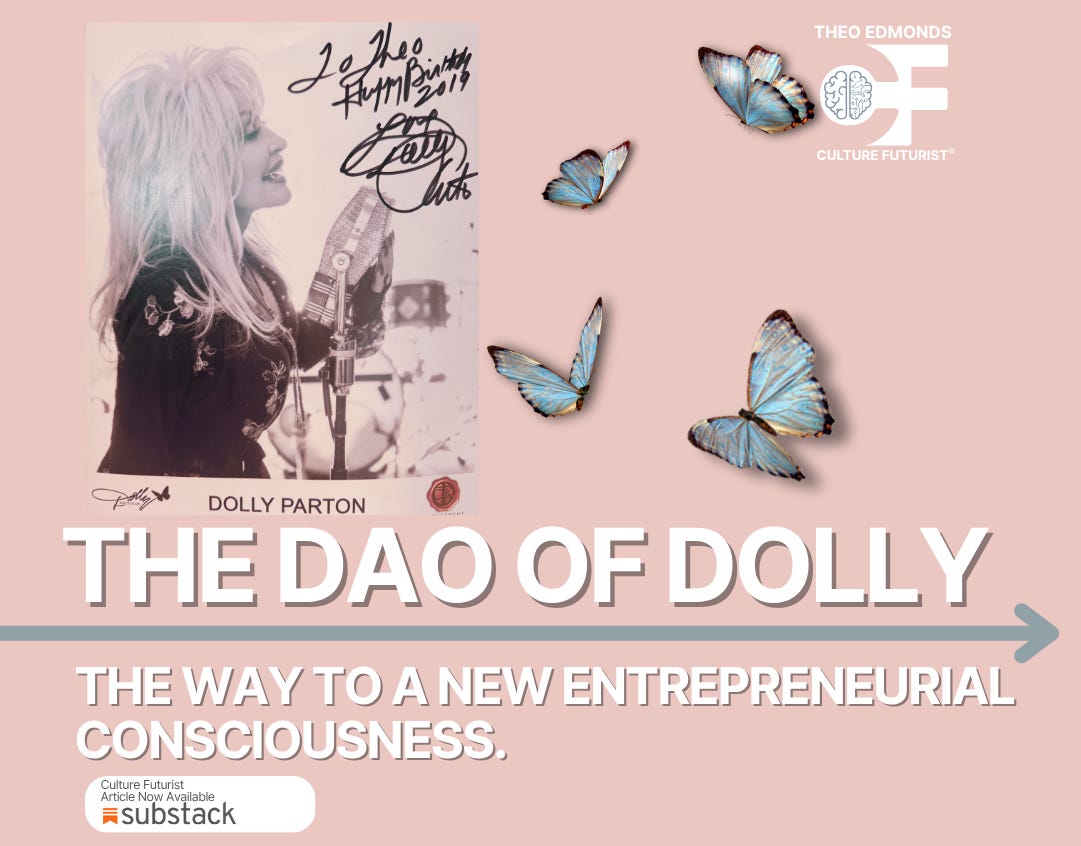
When I turned fifty, my husband threw me a surprise Dolly-themed birthday party.
Everyone came dressed as an homage to Dolly from a favorite period of her career. Apples to Apples had been reimagined as “What Would Dolly Say?” Fifty photographs of me, drawn from across my life and selected largely for their potential to embarrass me, became the prompts. Guests drew cards printed with Dolly quotes and competed to find the one that best matched each photo.
There was a Dolly drag queen singing “Happy Birthday.” There was a cake shaped like, well, one of Dolly’s most celebrated assets. And there was a signed photograph of Dolly marking the occasion. It has hung on my refrigerator ever since.
That barely scratches the surface of what Dolly Parton has meant to me.
For the past two weeks, I’ve been trying to figure out how to write something that conveys the depth of the loss I feel, a loss I know I share with millions of other people. I can’t do that right now.
So instead, I want to write about what Dolly taught me.
My love affair with her began during America’s bicentennial. As the country turned 200, I turned six. For most of the next year, I was glued to The Dolly Parton Show every week. She opened with “Love Is Like a Butterfly.” She closed with “I Will Always Love You.”
I didn’t know it then, but that song already contained one of the lessons I would come to admire most about her.
In 1974, Elvis Presley wanted to record Dolly’s song. Dolly wanted him to record it too. Then Presley’s manager, Colonel Tom Parker, told her the deal required at least half the publishing. She said no. Years later, she remembered crying because she had wanted to hear Elvis sing her song. Whitney Houston was still eighteen years away.
I’ve thought about that a lot over the years. Dolly knew the intellectual property rhythms of the music industry. Keeping control of her song meant giving up the chance to hear Elvis sing it. I like to think he did, privately, sometime, when it was just the two of them.
Dolly held onto her publishing and lived with the disappointment. It’s an uncertain thing to decide, in the moment, what an opportunity is allowed to ask of you. Before life and time hand possibility the benefit of hindsight, tough calls are just that. Tough.
For thirty years, my career moved through American systems that would offer tidy, neat categories for what Dolly did. Business and law labeled her decision as savvy use of intellectual property. Arts lauded her artistic integrity. Psychology research pointed to the values, identity, and the capacity to tolerate the pain. It was Elvis, after all. For younger readers, Elvis at the time was bigger than Taylor Swift and Beyoncé together. Industry, arts, and science all have different professional ways to describe parts of the same human experience. None do a very good job on their own of seeing Dolly Parton and the path she was taking.
I’ve always been drawn to understanding how different spiritual traditions grapple with our big human questions. There is a Chinese word, Dao, which means way. Not the binary predetermined choice of this way or that way. But a way through life that contains what Walt Whitman named in his famous line from Leaves of Grass when he wrote, “I am large, I contain multitudes.”
Many Paths
Dolly built her life, in part, by questioning our habit of treating inherited categories and social conventions as if they exhausted the possibilities for living.
Growing up in Southeastern Kentucky, Appalachia taught me early that leaving a place and belonging to it can happen at the same time. People leave home for many reasons. Education, safety, work, distance, possibility. As years pass, the distance and time make you feel like those long-ago memories may actually be a hallucination from someone else’s life. All the corporate static and prodigal junk layer themselves thick as mud as you hide deeper and deeper to fit what systems of power and money reward. Then a word comes out of your mouth one day during a meeting, thick as sorghum, and there is Appalachia standing with you again.
We all know Dolly’s story by now. Most news outlets tell it as if it begins when she left home for Nashville right after high school. But she became one of the most recognizable people in American culture by carrying her home with her. Those hills, hollers, and humans inhabited her songs, humor, visual language, businesses, stories, and eventually her understanding of what an enterprise could return to the people who lived there.
Most entrepreneurship case studies in business schools treat success as a form of departure. Leave the small town, the old industry, the inherited rules. Head toward the place where the opportunity is larger and build the future there.
Dolly troubles that story. She left and kept returning without moving backward.
That’s a feat harder than most of us will ever gain the know-how to make real in our own lives. It’s also how Dollywood makes sense to me. She placed part of her expanding global enterprise in the place that formed her. Her choice brought work and investment along with a mixed bag of consequences that always accompany tourism and economic development.
Affection for a place does not settle those, but it does put the entrepreneur in a relationship of creative tension with them. More than that, it requires the willingness to sit inside unresolved tension for as long as it takes to find a third way. Especially when it’s not comfortable.
The place a person comes from can remain a participant in what an entrepreneur builds, with interests that continue after the founder leaves and after the investment arrives. Home itself may change too, which means remaining in relationship with it takes something deeper than nostalgia.
Dolly kept moving while home kept moving with her.
Wuwei
In the Dao, Wuwei is often translated as “nonaction,” which makes it sound passive. But, as I understand it, it means that we should avoid grasping, excessive desire, and the effort to impose order through force. It’s less that we shouldn’t strive for things than an invitation to examine what drives us in our striving.
Dolly sure wasn’t short on effort. Nobody writes and records that much music, protects ownership across decades, rides shifts in popular culture, and builds a global enterprise without discipline. Her public life does, however, ask us to focus on where our professional effort goes.
She did not sand away the accent, abandon country music when Hollywood opened, or redesign herself around conventional ideas of intellectual seriousness.
She got blonder and sparklier.
I laugh when I think about that. American professional culture teaches us to spend enormous amounts of energy managing how other people interpret us. We learn the codes of the rooms and the social media channels. A never-ending game of tweaking what we wear, do, and say for approval. Our biographies, language, even pieces of personality get adjusted until we resemble the kind of person institutions already know how to reward.
Of course, some adaptation is needed for communication, growth and survival. No judgment here for anyone who does it when they enter rooms not built with them in mind. Lord knows I have racked up my share of it over the years. The problem comes when accommodation becomes so entangled with ambition that we stop noticing how much of our effort goes into the work and how much goes into making ourselves “acceptable” to the people controlling access to it.
Dolly exaggerated characteristics that could invite powerful people to underestimate her, then kept producing work they had to reckon with. I can scarcely imagine what that cost her privately. I can see that our love of her didn’t ask her to imitate the appearance we might normally associate with authority. Refusing to force can carry its own force.
I shudder a little to think how much effort I’ve expended over the years that took me out of my own work. Spending this one wondrous life forcing my spirit into an “authorized shape” seems less worth the carry when I look at that signed photo of Dolly on my fridge every time I need some milk.
Uncarved Rhinestone
The Daoist image least compatible with Dolly may be pu, the uncarved block. The image evokes simplicity and an integrity that our ego needs and cultivated desires get all twisted up inside us.
Almost nothing about Dolly’s public appearance was uncarved. Hair, nails, makeup, clothes, rhinestones, heels, proportions, jokes, theatrical excess. The construction became part of the joke. Dolly spent decades showing us that Dolly Parton was something she made.
People experienced her as authentic anyway.
The endless social feeds with quotes and tropes on pop spirituality imagine an authentic self buried beneath everything culture has added. Remove the performance. Drop the mask. Find the person underneath. Dolly complicates that picture. The uncarved part of any of us may have less to do with appearance than with our continuing authorship to choose what covers and creatures us.
A costume can be chosen. A professional identity can help us move through a particular institution. A business can give ambition a structure. But then, one day, the structure starts talking back. The audience expects “this.” The brand cannot survive “that.” A person in “your position” cannot say such a thing. Success produces its own set of instructions, and following them can slowly become indistinguishable from protecting what we have built.
Dolly’s authenticity was large enough to accommodate change. That’s maybe the harder test I’ve been molting my way through over the past couple of years. To find a version of “me” that’s even more meaningful, can I reconsider what I have made, including the version of myself that other people reward?
Dolly carved the hell out of the block and still, in choices we can point to, protected the wood.
Opposite Truths
Dolly looks decidedly artificial, but somehow she feels very much like herself. She accumulated millions of dollars, but identified with the poor and the humble. She fought to protect what she owned, but time and again demonstrated willingness to give and spend money. She remained attached to a singularly specific set of cultural patterns but reached audiences who have nothing to do with that culture.
Our typical instinct is to see such paired traits in any of our own lives as inconsistencies that need explanation. But Daoist thought offers another approach. Opposites may depend on each other. Our inherited categories can reduce differences into hierarchies they do not, in and of themselves, contain. Elaborate and simple do not, by themselves, signal value, nor do soft and strong. This is an important distinction for those who have long considered creativity, emotional intelligence, and curiosity “soft skills” in corporate America. AI is showing us that these are now the hard skills everyone needs. When every company has access to essentially the same technology and answers, differentiation comes from the questions. Value, economic or cultural, is a matter of perspective.
I know this firsthand. Beyond my Appalachian background, I’m also gay and neurodiverse. I know it from moving back and forth among the identities of artist, researcher, entrepreneur, and executive. For a long time, I assumed the goal was to integrate it all into a coherent professional identity that would make sense to everyone.
Dolly showed me that coherence may not require resolution. Creative power may come from our willingness to hold parts of ourselves that the culture insists should cancel each other. The artist asks the questions the executive would rather have settled. The researcher insists on evidence that enthusiasm cannot provide. The corporate executive commits before she is fully informed. Each pressures what the others are allowed to assume.
There is also probably a cost. Something gets lost in translation when we work too quickly to make disparate parts agree with each other.
Contradiction can become its own hiding place too. Holding the tension earns its value only when it helps us perceive and respond to more of the situation. If it becomes an excuse to avoid making a decision, then it stops doing the useful work of pointing to the third way forward.
Dolly never needed to reconcile rhinestones and seriousness. She walked into serious rooms with rhinestones visible to everyone.
Dolly’s Genius
We’ve made genius lonely in America. Our cultural picture usually locates it inside an exceptional person, the founder, artist, scientist, inventor, or athlete whose unusual capacity separates them from everybody else. Older language points elsewhere. A genius could be a guardian spirit associated with a person or place.
The image feels Appalachian to me. Nothing in the mountains exists alone for long. The holler explains the ridge. The ridge explains why the sun comes up at 10 am and sets at 3 pm. Family explains why the dead appear in the speech of the living. Place enters the body, and the body carries it somewhere else.
You can explain a great deal of Dolly through her individual talent, discipline, creativity, and choices. But then, there was her mother singing, Uncle Bill Owens, Porter Wagoner, Nashville musicians, Appalachian storytelling, people recognizing themselves in her songs, local organizations helping books reach children.
The Imagination Library makes that last relationship visible. Dolly’s name could invite people in. Getting books into children’s hands required a network of people and institutions.
In this way, the border around genius starts to move. Dolly remains visible, and so do the conditions and relationships that made her work possible.
That changes what I think we should build around exceptional people. Celebration is easy. The harder work is noticing the relationships that helped a capacity develop, the collaborators who made its expression possible, and the conditions through which somebody else might grow.
Dao of Dolly
We keep encountering the same problem in American creativity and entrepreneurship. We separate the artist, scientist, and business builder into different institutions and professional identities. As we’re learning with AI, innovation can become technically accomplished while losing touch with some of the ways human beings perceive, question, judge, and make meaning.
Dolly’s death has made me wonder if it’s time for a new entrepreneurial consciousness.
AI increases the pressure. I can ask a machine for another version, another interpretation, another possible direction, and another after that. I still have to decide what the work is trying to do. I still have to recognize when an answer is adequate and when technological polish has made an unresolved question easier to ignore.
Authorship is much more than what an algorithm strings together in a series of most likely words. Where did the ideas themselves come from and why? That’s the more valuable territory to mine. Dolly’s example gave us a way to think about that capacity through choices she let us all see. She could use a form without letting it govern every decision. She could remain in relationship with a place while both she and the place changed. Different parts of her life could put pressure on one another without collapsing into a single, easy definition. Something she made could remain hers while other people gave it meanings she never could have produced alone.
None of this offers a formula for choosing well. Refusal can come from principle or fear. Persistence can protect a commitment or extend a mistake. Finding a way requires judgment that remains answerable to consequences.
In hindsight, Dolly’s refusal to sell Elvis’s manager her publishing rights is easy to admire. We let the reward explain the judgment, and the uncertainty disappears.
Suppose Whitney had never recorded the song. Suppose keeping the publishing produced no extraordinary financial return. Would there still be something worth examining in Dolly’s choice?
For me, yes. She understood the terms. She wanted the opportunity. She decided that the opportunity asked too much of her.
The disappointment did not tell her whether she had chosen wisely. It certainly did not tell her what would happen eighteen years later. She had to continue without that information.
Dolly cried because she wanted Elvis to sing the song. Then she kept the publishing and went back to work.
The rest of the path had not happened yet. Dolly defined her way forward.
Now, that is a fact of history.
Through her, we can see what history looks like when it is carried instead of performed. I will always hear mountains of sky in her and never once feel asked for sympathy. That’s the thing about authenticity: it doesn’t beg. It sings like roads across decades, across death, and lands beside us. Like when we sit with all of our strangers, together and individually at the same time, in a darkened movie theatre watching flickers of light tell us our stories on the screen.
We loved her in collective and individual ways. Like Dolly, the presence of one did not diminish the other. In this way, intimacy is paradoxical, I suppose. Sometimes the closest voice belongs to someone you will never meet.
Until you let the dead hold you.
This is the work of wonder.
