Think Inside the Box
The carbon and consciousness problem in America’s creative industries.

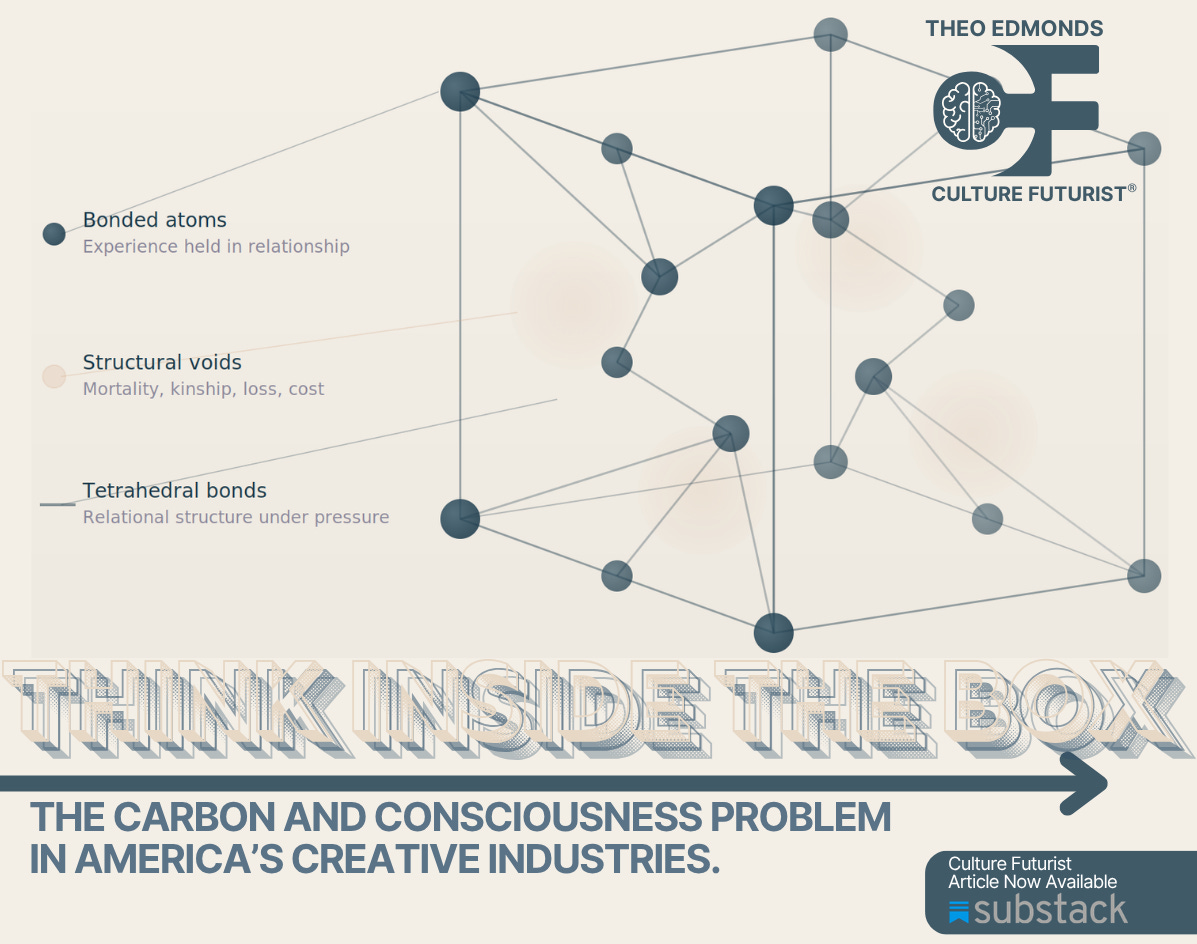
I. The Search
I spent the weekend diving pretty far into learning more about one of my favorite directors, David Lynch, decades long commitment to transcendental meditation. It’s deep. It also got me thinking a lot about the structures America has built to move creativity at scale across culture and commerce.
Creative industries have spent decades investing almost exclusively in agency: faster tools, more data, greater computational power that produce extraordinary spectacles of film, games, and immersive experiences. That investment has built immense industry capability. The foundation beneath it remains thin.
Last week, the Otis College Report on the Creative Economy, a milestone event for nearly 20 years, offered up new insights into the state of the creative industries.
Between 2022 and 2025, California’s creative economy lost 114,000 jobs, a 14 percent decline. Film and television alone contracted by nearly 30 percent. The instinct is to blame artificial intelligence.
But the 2026 report found that the roles most exposed to AI were actually growing.
The losses came from structural factors: cost-driven contraction, the collapse of conventional wisdom economics in TV, and a workforce priced out of the state. As one researcher put it, the pattern of job loss simply does not support the idea that AI displaced these workers.
The jobs disappeared because of how the industry was organized. The problem was structure.
This is an economic observation and a human one. Every aspiration for more, in whatever way we conceive of it, represents a step of personal and collective evolution. We want more reach, more capability, more intelligence, more creative power. And for decades, the dominant strategy has been to build outward: more tools, more speed, more output. The drive is real. The direction has been incomplete.
Einstein observed that problems require a different level of awareness than the one that created them. We have been building awareness in one direction, capability, while letting the other direction, consciousness, meaning, the interior life, fall further behind. The search for what would make the whole thing hold has led everywhere except inward.
II. Carbon
Diamond and graphite are made of the same thing. Pure carbon.
The difference between the hardest natural material on earth and the soft gray stuff inside a pencil depends on how the atoms are arranged. In graphite, carbon atoms bond tightly within flat sheets but barely hold on between them. The layers slide apart easily. That is why pencils work: you are smearing sheets of carbon across paper.
In a diamond, every carbon atom bonds to four others in a rigid three-dimensional lattice. Same ingredient, completely different material. The defining difference is structure.
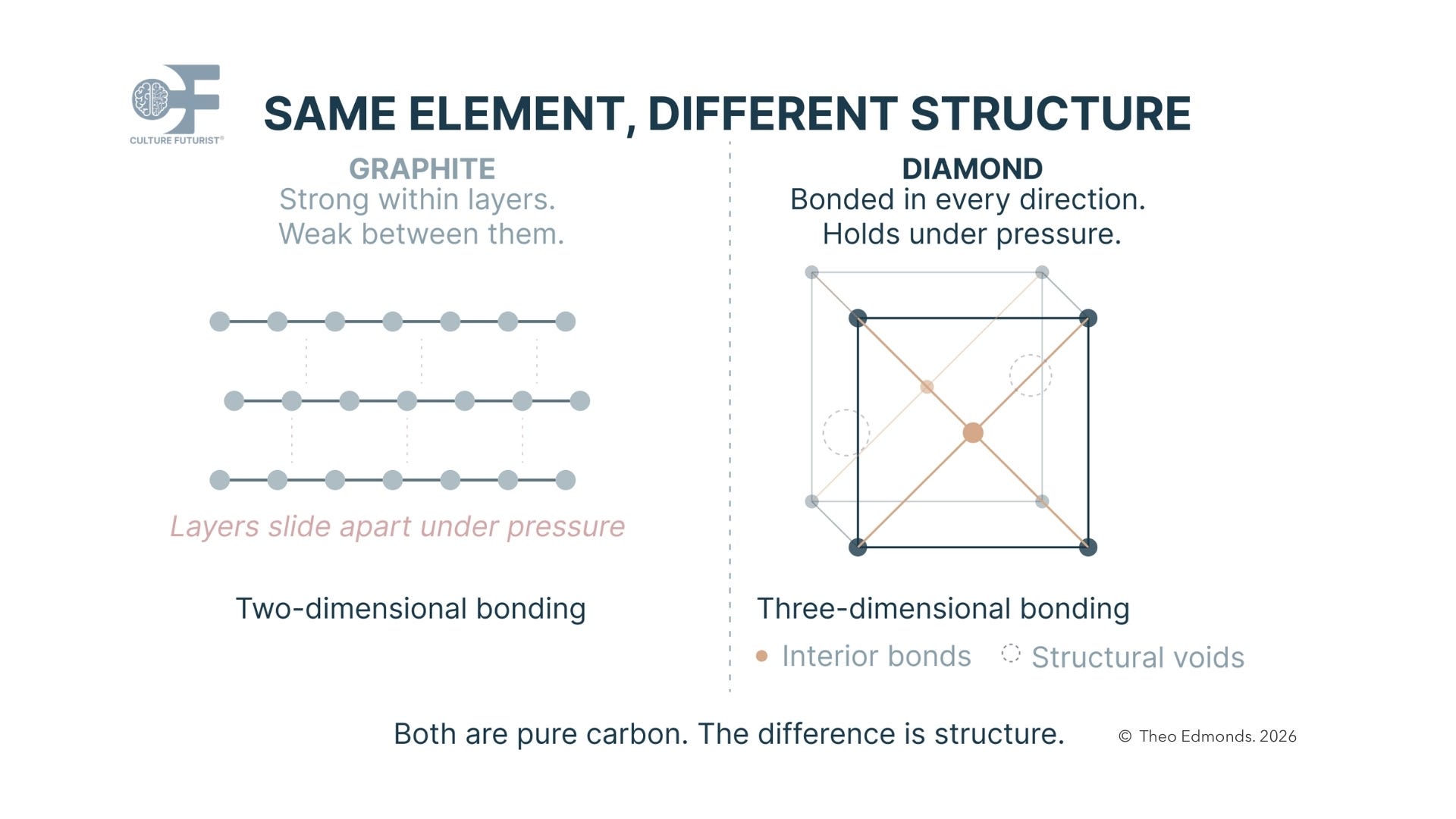
To me, this feels like an important metaphor for understanding human creative capacity in the age of AI. At the atomic scale, diamond’s strength comes from the geometry of its bonds. The lattice is defined as much by its voids as by its atoms. Look at it under an electron microscope, and you see a structure built from bonded carbon and empty space in precise proportion. The relationship between presence and absence is what makes the whole thing hold.
Artificial intelligence is, in structural terms, graphite. Powerful within a given domain but limited in how it integrates across them. Strong within layers, weak between them. When pressure comes, the layers slide apart.
Diamond is the human creative advantage of teams. Same base element as graphite: human knowledge, human pattern, human language. But bonded in three dimensions under pressure, with a structural void built into the lattice. Light enters a diamond and transforms. It bounces, refracts, and disperses into a spectrum. The same structure that gives a diamond its strength also gives it its brilliance. That brilliance is a property of the relationships.
California’s creative economy was organized like graphite. The atoms were carbon, the same carbon that makes diamond. The jobs disappeared because the bonds between them could not hold under pressure.
III. The Source
Every carbon atom in a diamond carries the same elemental identity. They are all carbon. But each occupies a unique position in the lattice, bonded to four neighbors in a distinct orientation. Diamond’s strength comes from bonding these different positions into a geometry that holds in every direction. Same element, different position, held under pressure.
Human groups work the same way. Every person carries a common humanity. Every person carries a different experience of it. The strength comes from bonding those different experiences into a relational structure where difference is load-bearing, and the whole holds under conditions that would break any individual alone.
A diamond’s unit cell (the smallest repeating structural unit of a crystalline solid, the one that defines the entire crystal’s 3D pattern) is a cube. Inside each cube are spaces filled with bonded atoms and “empty” spaces.
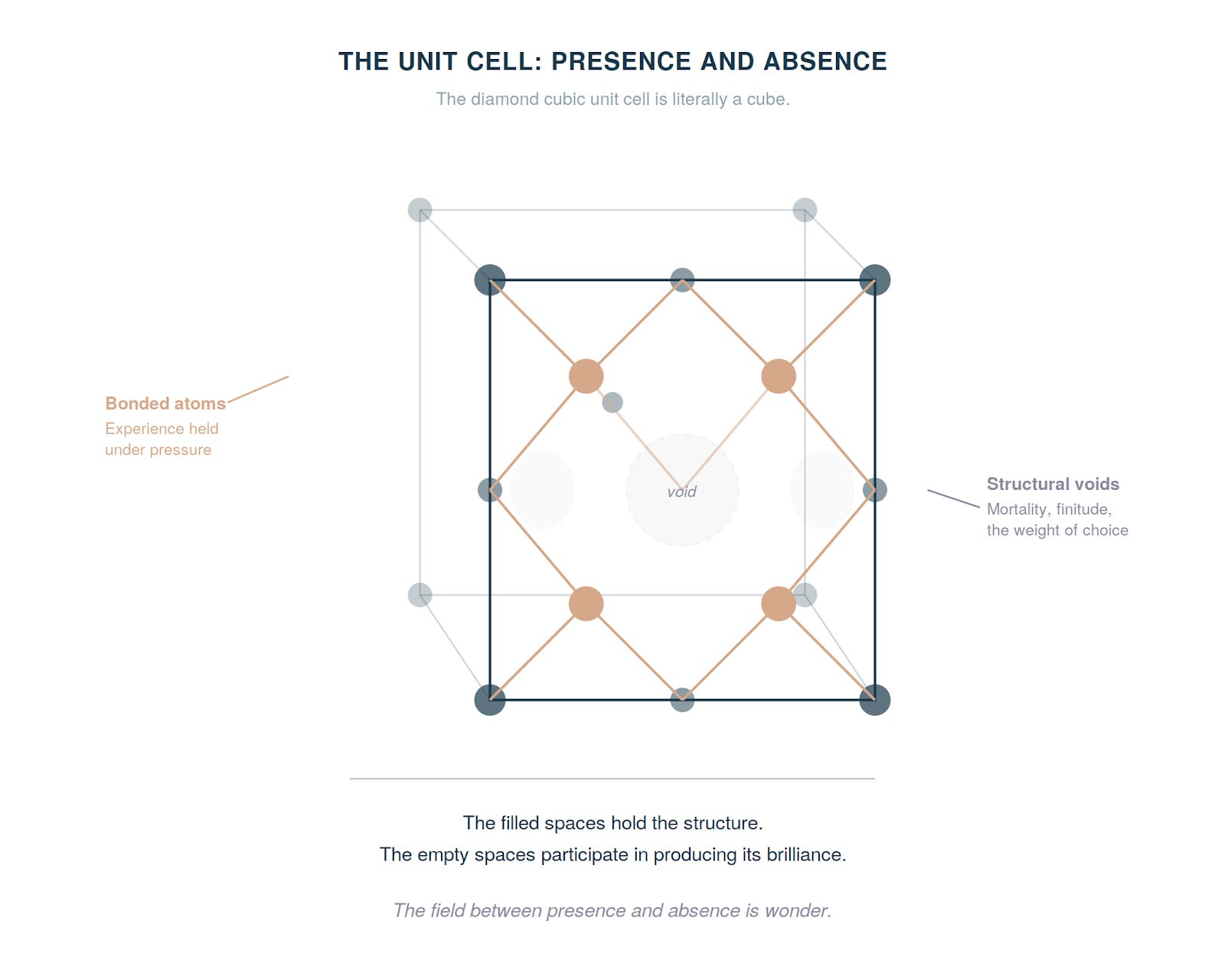
A diamond gets its hardness from the carbon atoms locked in place, the filled spaces. That’s the structure. But a diamond gets its brilliance from the empty spaces inside the crystal lattice. Light enters, hits those voids, refracts, bounces internally, and exits. The empty spaces are what make it throw light.
In human creative work, I think the structural emptiness is like our mortality. We create with the awareness that we are in a body that knows it will die. I think it may be our distinct human creative advantage over machine intelligence.
Max Planck, the physicist who originated quantum theory, described what he found at the bottom of physics this way: the instruments of measurement are inseparable from the awareness doing the measuring. He regarded consciousness as fundamental, matter as derivative from it. Everything that we talk about, everything that we regard as existing, assumes some level of consciousness.
This is a claim about the source, about what lies beneath the surface activity of thought and production.
The deepest level of creative capacity is a quality of awareness, shaped by the conditions of being alive. There is a word for what happens at the boundary where awareness meets what it has yet to understand. The word is wonder.
Wonder is a field of influence that shapes human understanding. It is the lived space between what a machine can compute and what a human being can comprehend. Computation closes gaps. Comprehension opens them, holds them, stays in contact with what has yet to resolve.
A machine can process every data point in a system and produce an optimized output. A human being can stand inside the same system and feel that the output, however correct, has yet to mean anything. That felt gap is where wonder operates. It is the source from which creative work draws its weight.
Mortality is what gives the field its depth. It is the structural emptiness at the center of every creative act. Mortality forces choice under finite time. It gives kinship, loss, and creativity their weight, because the relationships end, the gone stays gone, and every act of making spends something irreplaceable. To create is to choose, knowing the choosing costs something, and to do it anyway.
Machines produce output without lived cost, without finitude. Their output, however efficient, trends toward sameness. There is no void in the structure. No gap between what was risked and what was gained.
This is our largest untapped resource. The field of wonder that only mortal, embodied, conscious beings carry. A field that grows more valuable as machines take over the production of everything that does not require it.
IV. Two Engines, Two Possibility Spaces
Human progress has always moved through two recurring processes. The first is material: people turn elements into tools, changing distance and reach. The second is symbolic: people use imagination to create language, art, music, mathematics, and theory, changing how we experience what time feels like. One reshapes distance through the body. The other reshapes time through the mind.
Taken together, these create two interdependent possibility spaces. Meaning: interpretation, coherence, the ability to make sense of experience. Agency: capability, skill, the ability to act on what you understand. The biggest turning points tend to involve both. The Enlightenment and Romanticism, arriving in tension with each other, changed how we experienced both distance and time: one through reason, the other through felt experience.
Life, then, has two aspects. An outer field of action and capability, and an inner field of meaning and awareness. The field of wonder lives at their intersection, where what we can do meets what we have yet to understand. Each aspect depends on the other. Discovery requires both. And wonder is what holds them in productive contact.
When meaning and agency stay in proportion, discovery is more likely to serve human benefit. When agency outpaces meaning for long enough, predictable things happen. Fear narrows reframing. Frustration burns out commitment. Fragmentation breaks coordination. Flatness drains the felt sense that anything produced actually matters. This is what I have coined as Innovation Grief™.
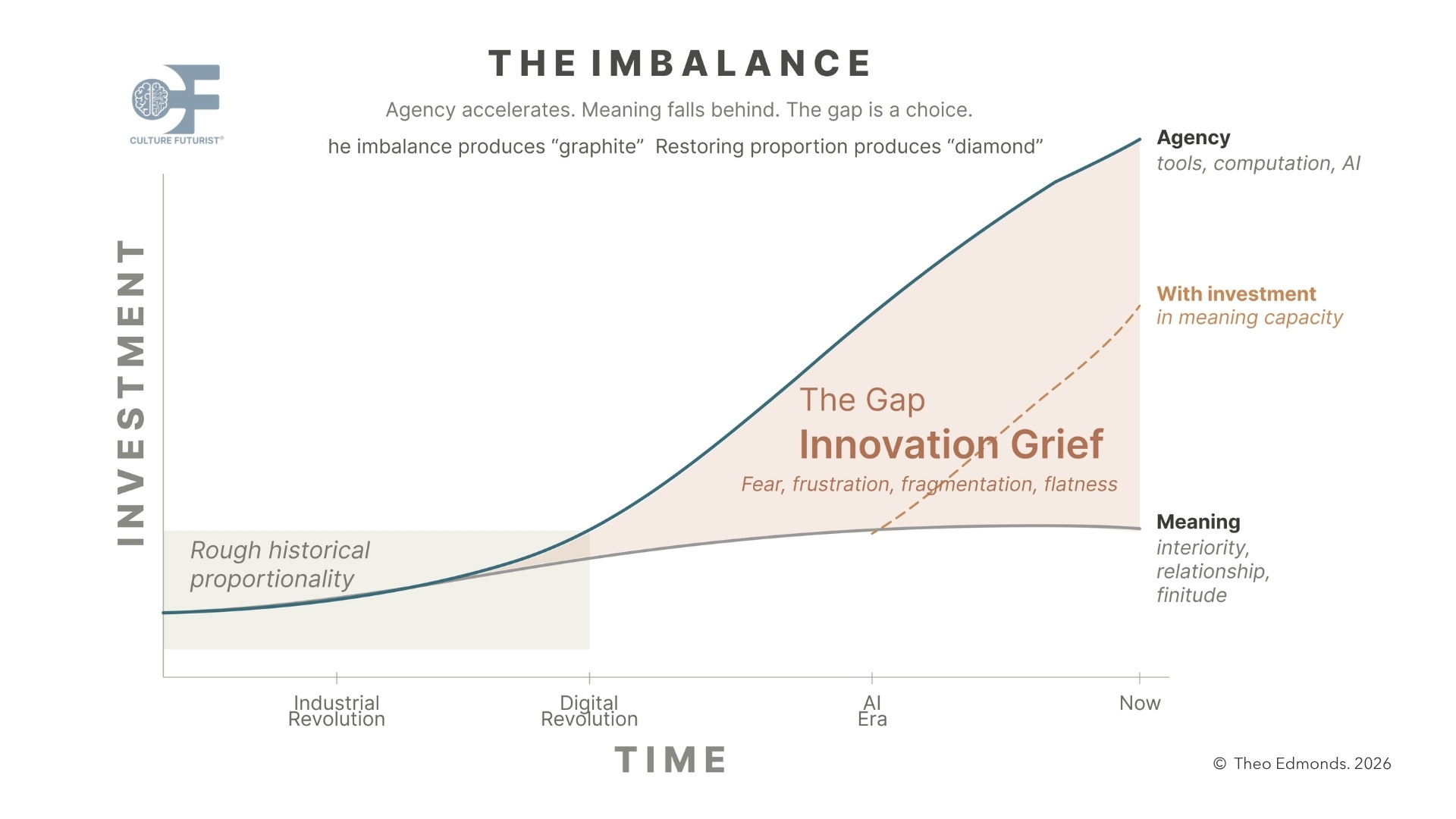
AI will intensify this dynamic. It extends the tool-making engine further and faster than anything in history. It compresses distance. It automates pattern-matching. It produces output at scale. And on current evidence, it cannot supply the other engine: the one that reshapes time, builds meaning, and depends on a body aware of its own limits.
The natural tendency of living systems is to seek integration. A mind confronted with a problem it cannot solve searches for something more complete. I believe that we must build the structures that allow that search to succeed. Continuing to invest only in one side of the equation has real, human consequences. Balance is critical for advancing human primacy as culture evolves with machine intelligence.
V. The Evidence of Structure
A nation that invests only in its atoms gets graphite.
A nation that invests in the relational structure that bonds different human experiences together under real pressure, while honoring the void that only mortal beings carry, gets diamond.
The evidence is already visible. California’s creative economy lost 114,000 jobs. Research reported that the problem was structural. The industry was organized like graphite, strong within layers, weak between them. When pressure came, the layers slid apart.
The same evidence appears wherever we look carefully enough. When teams function with coherent integration across their differences, bonded in three dimensions rather than layered in two, they produce outcomes that individuals and machines alone cannot generate. When the bonds between different positions are load-bearing, and the relational geometry holds in every direction, the structure transforms what enters it.
Light enters diamond and disperses into spectrum. That brilliance is a property of the whole structure: the bonds, the voids, the precise geometry that holds presence and absence together.
For fifty years, “think outside the box” has been the default metaphor for creativity in American business. It assumes structure is the enemy. That innovation follows escape.
The diamond unit cell, visible at the atomic scale, is literally a cube. The box is the structure. And the structure is where brilliance happens. Our bonded experience and mortal search for meaning held in balanced proportion.
Human creative advantage is only possible when the light of uncertainty enters our structures, moves us through the frontier of the familiar: the boundary where what a team already knows meets what it has yet to understand.
That frontier is where wonder lives inside a culture and commerce, at the precise place where the known lattice ends and the possibility of another possibility begins. Culture and commerce are both group architectures that hold human experience and human finitude together. It is the pressure between meaning and agency that produces something beyond what any individual or any machine could generate alone.
Carbon under pressure, in the right relational geometry, becomes the hardest and most brilliant material known. The difference is a question of structure.
The more machines learn to optimize what is predictable, the more human advantage depends on our capacity to sense what is still emerging.
This is the work. The future of creative work.